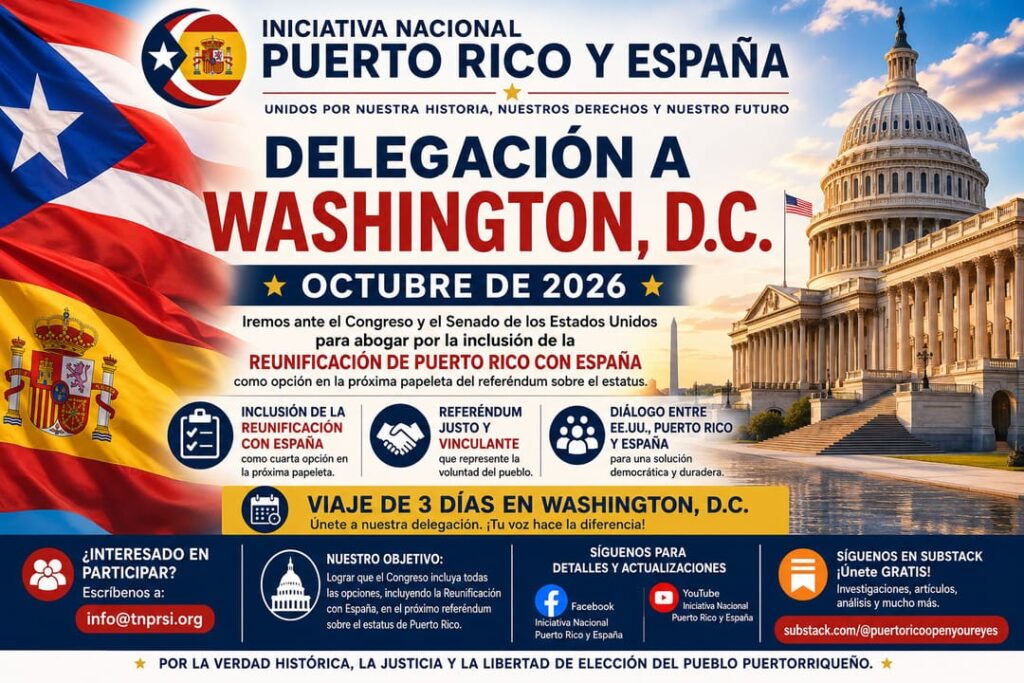
I was inspired to write this after coming across a post on my Facebook feed. It made a strong statement one that, at first glance, might sound convincing. But after taking a step back, I realized it was based more on emotion than on historical or factual understanding.
So instead of responding directly to that individual, I decided to share this here so anyone who comes across it can take a moment to reflect on the facts, the history, and the reality of Puerto Rico’s situation.
Are you the same person today that you were 20 years ago? The honest answer for most people is no. So how is it that some still try to judge entire nations based on what happened 400 or 500 years ago, as if nothing has changed?
It’s interesting how people say that moving Puerto Rico from one “slave master” to another is somehow the same thing, referring to Spain and the United States. That statement might sound powerful, but it ignores both history and present-day reality.
Spain today is not the Spain of centuries ago. Spain is a modern democratic constitutional state, a member of the European Union, where regions such as the Canary Islands, Catalonia, and others operate with their own parliaments, budgets, and administrative control over key areas like education, healthcare, infrastructure, and taxation. These are not colonies. These are autonomous communities with real governing authority within a democratic system.
To understand this conversation, we also have to understand what Puerto Rico actually had before 1898.
In November 1897, Spain enacted the 1897 Autonomic Constitution (Constitución Autonómica) for Puerto Rico. This was not symbolic. It was one of the most advanced political arrangements Spain had granted at the time, and it applied specifically to Puerto Rico and Cuba.
Under this system, Puerto Rico was established as a self-governing constitutional entity within the Spanish framework. The island had its own elected Parliament, divided into two chambers, and control over its internal affairs, including taxation, education, public works, and local governance. Spain retained authority over defense, foreign relations, and national sovereignty, but internally, Puerto Rico governed itself.
This level of autonomy was highly significant for its time.
Spain itself, under the Constitution of 1876, was still largely centralized. The modern system of autonomous communities that exists today did not emerge until after the 1978 Spanish Constitution, roughly 80 years later.
In other words, Puerto Rico and Cuba were granted a form of political autonomy in 1897 that closely resembles aspects of the decentralized governance models Spain would not fully implement within its own national structure until the late 20th century.
Elections were held in March 1898, and Puerto Ricans elected their own government under this autonomous system. For the first time in its history, Puerto Rico had a functioning, democratically elected government with control over its internal affairs.
That system did not collapse on its own.
It was interrupted.
In 1898, during the Spanish-American War, the United States invaded Puerto Rico under the command of General Nelson A. Miles.
According to documented writings and reports from General Miles and other U.S. officials, they did not arrive to find a collapsed or disorganized territory. They encountered a functioning society with established civil institutions, local governance, and an organized population already operating under the newly implemented autonomous system.
This is not speculation. These observations come from firsthand accounts recorded during the campaign.
In other words, Puerto Rico was not a political vacuum.
It was a society already exercising a form of self-government when that process was interrupted by military intervention.
Shortly after, under the Treaty of Paris, Spain ceded Puerto Rico to the United States. With that transfer, the autonomous government that Puerto Ricans had just established was dismantled.
What followed was not autonomy.
It was territorial rule.
Puerto Rico today is an unincorporated territory of the United States, as defined by the Insular Cases of the U.S. Supreme Court it belongs to the United States, but is not part of the United States. That distinction is critical. It means Congress holds ultimate authority over the island, and full constitutional rights do not automatically apply in the same way they do in the states. That has been the legal reality for more than 125 years.
And here is something else people rarely talk about.
Puerto Rico has held multiple plebiscites and referendums over the years to determine its political status. But ask yourself this:
Why have none of them resulted in a final resolution?
Because none of those votes were initiated or authorized by the United States Congress.
They were initiated at the local level by the Puerto Rican government, and while they reflect public opinion, they are non-binding. Congress is not obligated to act on them and historically, it has not.
That is why these referendums are often labeled as inconclusive.
Not because people didn’t vote but because the authority to make a final decision does not lie in Puerto Rico.
It lies in Congress.
Now let’s also talk about history honestly, without selective outrage.
Slavery existed in Puerto Rico, as it did across much of the world. But it was not exclusively imposed by one external group alone. There were Puerto Rican elites who participated in that system. Families such as the Serrallés family in Ponce, known today for Don Q rum, were part of the plantation economy during the 19th century when slavery existed. There were also local political and economic figures connected to municipal leadership in places like Ponce.
Historical records also show that in different parts of Latin America and the Caribbean, including Puerto Rico, there were cases of free Black individuals who became slave owners under that same system.
This does not justify slavery.
It reveals something more important.
History is complex. It does not belong to one group alone, and it cannot be reduced to simple labels.
Now let’s bring this conversation back to the present.
Many people advocate for independence. That is a valid position. But independence, in practical terms, would be a transition into a completely new system. It requires economic stability, institutional readiness, restructuring trade, and long-term planning. That is not impossible but it is, by definition, an untested path for Puerto Rico in its modern context.
Statehood is also presented as a solution. But even if it were granted, it does not automatically mean full control or equal influence in practice. The United States operates under a political system where power is constantly reshaped. We have seen how political lines are redrawn, how influence can shift, and how representation can be diluted. That is the reality of the system.
So the question becomes:
If Puerto Rico were to become a state, who guarantees that its influence would not be limited or absorbed into a structure where decisions are still driven by national priorities over local needs?
Now compare that to what Puerto Rico already had.
In 1897, under the 1897 Autonomic Constitution, Puerto Rico had a functioning government. It was not an idea. It was not a proposal. It was not a theory.
It was real.
Puerto Rico had its own Parliament, control over its internal affairs, and the ability to govern itself within a constitutional framework. That system was already in place, already operating, and already demonstrating what self-governance could look like.
And this is the part many people overlook.
Had that system not been interrupted in 1898, Puerto Rico would have likely continued evolving within that autonomous frameworkmuch like what we see today in Spain’s modern system of autonomous communities.
Regions such as the Canary Islands, Catalonia, and others operate with their own parliaments, manage key areas like education, healthcare, infrastructure, and taxation, and maintain a high degree of internal self-governance within a national structure.
In other words, the structure Puerto Rico briefly experienced in 1897 closely resembles the type of governance that exists today in Spain’s autonomous regions. It was not an experiment. It was a functioning reality cut short. So when we talk about options today, we have to be honest.
Independence is a vision.
Statehood is a possibility.
But autonomy is something Puerto Rico has already experienced and something that has a modern, working equivalent today.
That matters.
Because it shifts the conversation from “What could work?” to “What has already worked and still works today.”
So let’s be realistic about our options.
What realistic option gives Puerto Rico true self-governance?
What system provides economic stability and growth?
What model allows Puerto Ricans to control their internal affairs without remaining in a territorial status?
This is not about going backwards. It is about understanding what existed, what was taken, what exists today, and what can realistically be built moving forward.
We can disagree on the path.
But if we are going to have this conversation, let’s base it on facts, history, and reality not on narratives frozen in time.