
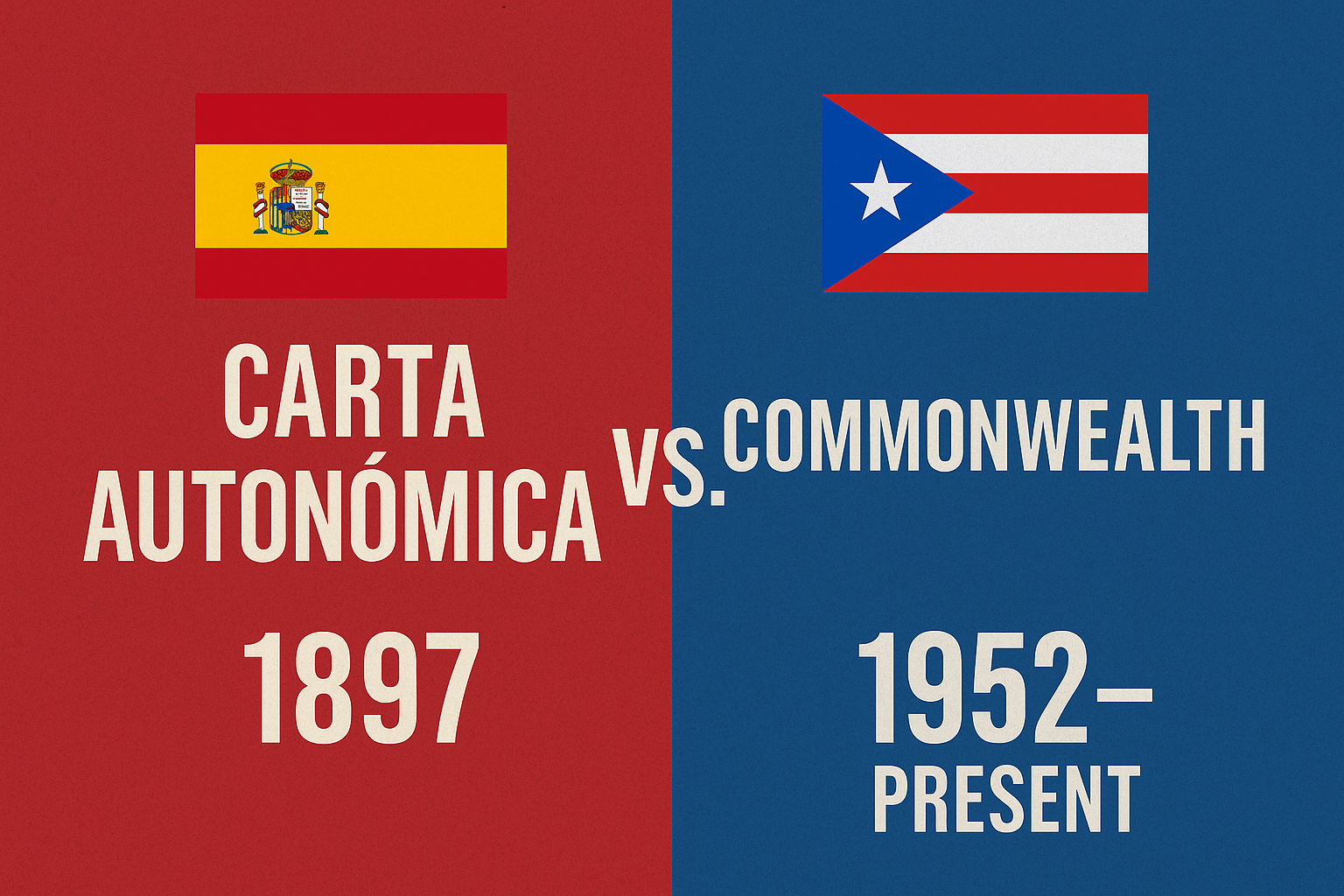
For over a century, Puerto Ricans have been told that their current “Commonwealth” status under the United States represents progress — a form of modern self-government. But few realize that, in truth, Puerto Rico enjoyed far greater autonomy, representation, and dignity under Spain’s 1897 Carta Autonómica than it does today under the so-called Estado Libre Asociado.
A Promise of True Self-Government
On November 25, 1897, Spain granted Puerto Rico its Carta Autonómica, a constitutional act that transformed the island into a self-governing province of Spain. This was not a symbolic gesture. It was a historic recognition that Puerto Rico was mature enough to govern itself within a constitutional monarchy — just like the provinces on the Iberian Peninsula.
Under this Carta, Puerto Rico established its own bicameral legislature, known as the Cortes Insulares, which held full authority over internal matters — commerce, taxation, public works, education, and local administration. The island also formed a Council of Government, responsible to its own elected parliament rather than to Madrid.
Perhaps most importantly, Puerto Rico retained representation in Spain’s national parliament. Puerto Rican senators and deputies could speak, vote, and defend the island’s interests directly in Madrid. Every Puerto Rican was also recognized as a full Spanish citizen, with equal constitutional rights and protection under the law.
This framework, if not interrupted by the 1898 U.S. invasion, would have allowed Puerto Rico to evolve — as other Spanish provinces did — into a prosperous, fully autonomous region integrated with Europe.
From Autonomy to Occupation
When the United States invaded Puerto Rico in 1898 during the Spanish–American War, it abruptly dismantled this system. Through the Treaty of Paris, Spain was forced to cede the island, and Puerto Ricans — without a vote, without consent — were stripped of their Spanish citizenship and provincial status.
For the next two decades, Puerto Rico existed in political limbo. It was neither independent nor fully integrated into the United States. The Jones–Shafroth Act of 1917 imposed a new form of citizenship — U.S. citizenship by statute — but did not extend the full rights or representation that come with it. The U.S. Supreme Court later classified Puerto Rico as an “unincorporated territory,” a possession rather than a partner.
The Commonwealth Illusion
In 1952, Washington rebranded Puerto Rico as a “Commonwealth” — a name that suggests equality but conceals dependency. Under this arrangement, Puerto Rico may elect its own governor and legislature, but every law, policy, and decision remains subject to the plenary power of the U.S. Congress.
Puerto Ricans cannot vote for president, have no voting representation in Congress, and live under federal laws they did not create. Even the island’s fiscal policy is controlled by an unelected Oversight Board (PROMESA), appointed in Washington.
A Tale of Two Systems
The contrast is striking:
| Aspect | Carta Autonómica (1897) | Commonwealth (1952–Present) |
|---|---|---|
| Sovereignty | Shared under Spain’s constitutional monarchy | Controlled entirely by U.S. Congress |
| Citizenship | Full Spanish citizenship | Statutory U.S. citizenship |
| Representation | Deputies and senators in Madrid | No voting members in Congress |
| Legislative Power | Autonomous over all internal affairs | Limited; subject to federal override |
| Legal Status | Province of Spain | Unincorporated U.S. territory |
Reclaiming the Forgotten Path
History is clear: Puerto Rico’s 1897 autonomy represented a higher degree of self-government, participation, and respect than its current colonial status. It was a partnership rooted in culture, language, and law — not subordination.
Today, as more Puerto Ricans rediscover this truth, a new movement is rising — one that envisions Puerto Rico reclaiming its rightful place as a modern autonomous region of Spain, fully integrated into the European Union, while preserving its Caribbean identity and sovereignty over its future.
It is time to reopen the conversation that was silenced in 1898.
It is time for Puerto Rico to decide, not as a territory, but as a nation — and as a people with history on their side.
The National Puerto Rico & Spain Initiative Contact: tnprsi.2030@gmail.com
 Follow us on Facebook: facebook.com/