
By The National Puerto Rico & Spain Initiative (TNPRSI)
When Boricuas Unidos en la Diáspora released their viral video exposing Puerto Rico’s $4.4 billionloss under Act 60, they struck a nerve. They showed what many Puerto Ricans already feel — that the U.S. colonial system is designed to extract, not empower.
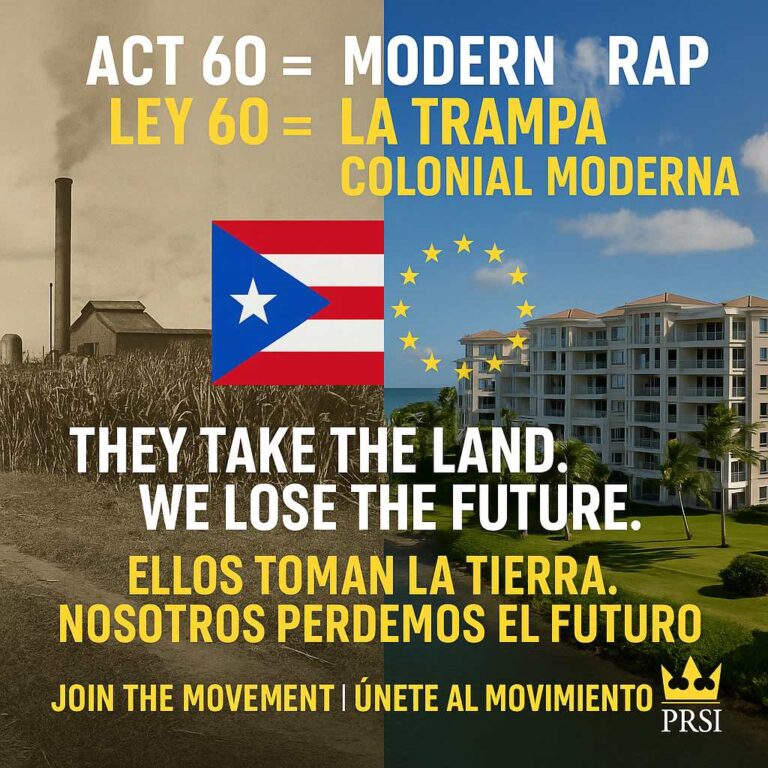
Act 60, disguised as the Incentives Code, has turned the island into a playground for outsiders. Millionaires and corporations buy land tax-free while schools close, hospitals crumble, and communities are displaced. Nearly 98 % of Puerto Rico has been designated as an “Opportunity Zone,” but the opportunities benefit investors — not residents.
History Repeats Itself
This is not new. When the United States invaded in 1898, it inherited Spain’s Leyes de Terrenos Baldíos— laws originally meant to verify land ownership. Instead of abolishing them, Washington used them to seize land from Puerto Rican farmers and hand it to U.S. sugar corporations.
By the 1920s, four American sugar companies controlled more than half of the island’s farmland. The most infamous was the American Sugar Refining Company — today known as Domino Sugar. What began as a law to register land became a tool for dispossession, transforming Puerto Rico’s economy into a colonial export machine.
The pattern is clear: whenever the United States gains control over Puerto Rican land, the people lose it. The same legal tactics that once built sugar empires now build luxury resorts and tax shelters.
Independence and Statehood: Two Faces of the Same Trap
Some argue that independence will break this cycle. Others believe statehood will fix it. History proves otherwise.
An independent Puerto Rico would face the same global market pressures and corporate lobbies — only without protection. A U.S. state, meanwhile, would give federal corporations even greater access to land and resources. Politicians already beholden to outside donors would gain new federal incentives to sell the island’s assets in the name of “investment.”
Both options keep the island dependent and unequal. Neither restores sovereignty or social justice.
Autonomy with Spain: A Path to Renewal
The only path that offers both self-government and stability is autonomy with Spain. Under this model, Puerto Rico would become an autonomous province within the Spanish constitutional framework — a system that guarantees broad powers of self-rule, while opening doors to the European Union’s protections and markets.
- Full local control through a democratically elected parliament and president.
- European labor, housing, and healthcare protections to prevent displacement and poverty.
- Access to EU funds for infrastructure, education, and renewable energy.
- A new constitution and transparent governance, free from the corruption of current colonial parties.
This is not nostalgia for the past — it is a strategy for the future. Autonomy with Spain would restore dignity, stability, and opportunity to Puerto Rico while preserving its unique culture and identity.
Join the Movement
Puerto Rico deserves to own its land again, rebuild its schools, and keep its wealth at home. The time has come to reject both colonial illusions — independence without protection and statehood without dignity — and choose a model that empowers the people.
Join the movement and become a believer and supporter of the National Puerto Rico & Spain Initiative.