
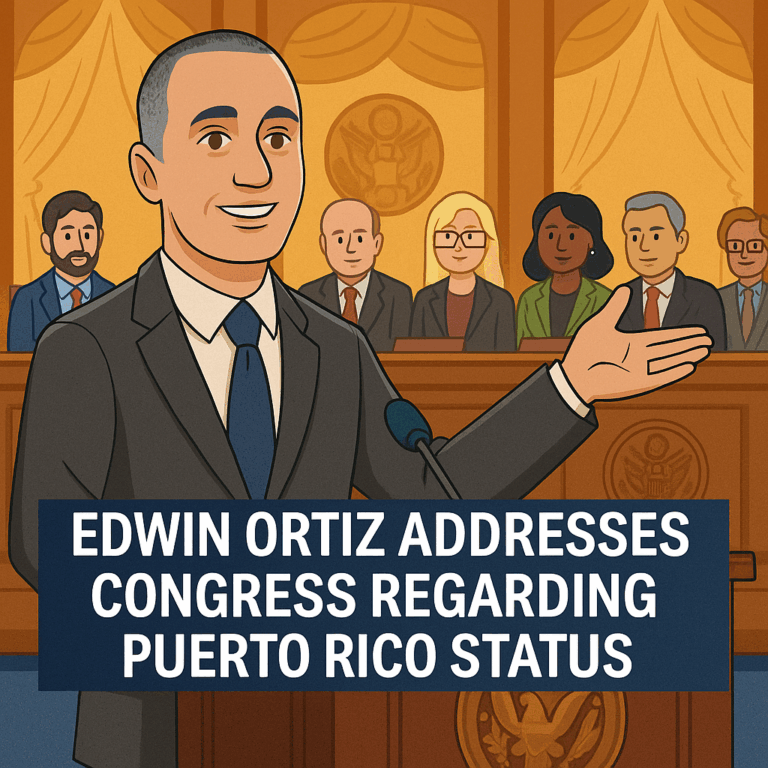
Request to Include “Autonomy with Spain” as a Formal Option in Future Puerto Rico Status Deliberations
By Edwin O. Ortiz, President, The National Puerto Rico & Spain Initiative (TNPRSI)
November 3, 2025
Introduction
The National Puerto Rico & Spain Initiative (TNPRSI) is proud to announce that a formal letter has been submitted to the U.S. House Committee on Natural Resources, urging Congress to recognize Autonomy with Spain as a legitimate and historically grounded option for Puerto Rico’s political future.
As President of TNPRSI and Petitioner in the United States District Court, I, Edwin O. Ortiz, write this message to reaffirm what history and law already make clear — that the people of Puerto Rico were lawful Spanish citizens prior to 1898, and that this nationality was unjustly interrupted through governmental overreach following the U.S. invasion and cession of the island.
A parallel petition is now being prepared for submission to the Kingdom of Spain.
Historical Citizenship and Ancestral Context
This cause is deeply personal. My grandfather, Antonio Carlos Ortiz Ramírez, was born in Puerto Rico in November 1897, the very month and year that Queen Regent María Cristina signed the Carta Autonómica de Puerto Rico, granting the island self-government and reaffirming the Spanish citizenship of its people.
For nearly a century before 1898, Puerto Ricans were recognized as citizens of Spain under multiple Spanish constitutions — the 1809 Decree of the Regency, the 1812 Constitution of Cádiz, and the 1876 Constitution — all of which declared:
“The Spanish Nation is the reunion of all Spaniards from both hemispheres.”
Under these constitutional frameworks, Puerto Ricans enjoyed full civic equality, representation in the Cortes (Spanish Parliament), and served honorably in Spain’s civil, military, and judicial institutions.
Loss of Citizenship and Governmental Overreach
This lawful relationship was broken in 1898 when the United States invaded Puerto Rico and imposed the Treaty of Paris, which denied native Puerto Ricans the right to retain their Spanish citizenship.
From 1898 until 1917, the people of Puerto Rico were left stateless, until the U.S. Congress unilaterally imposed U.S. citizenship through the Jones–Shafroth Act — without referendum, consent, or recognition of the island’s prior legal identity.
The later Insular Cases (1901–1922) entrenched this injustice by describing Puerto Rico as an “unincorporated territory,” a term built upon racially discriminatory reasoning. Those rulings, never overturned, still define the island’s status today — a constitutional contradiction that continues to deny Puerto Ricans equal footing within the United States.
Cultural Continuity and Strategic Alignment
Even after 125 years, Puerto Rico’s language, traditions, and institutions remain profoundly Spanish in character. Over 95% of Puerto Ricans speak Spanish as their first language, and the island’s civil code, education system, and customs are still modeled after Spanish and European frameworks.
Puerto Rico never fully assimilated into the Anglo-American system — because its roots are not American; they are Spanish.
Restoring Puerto Rico’s autonomy within the framework of the Kingdom of Spain would not be an act of separation, but an act of restoration. It would honor the island’s culture, history, and identity while strengthening the existing ties between the United States and Spain, both NATO allies and close economic partners.
Through lawful and democratic means, this initiative seeks to establish stability, accountability, and cultural preservation for Puerto Rico — and to build bridges, not walls, between the U.S., Spain, and Latin America.
Legislative Request
We respectfully call upon the U.S. House Committee on Natural Resources and its Subcommittee on Indian and Insular Affairs to:
- Acknowledge “Autonomy with Spain” as a valid and historically grounded status option for Puerto Rico’s political future.
- Include this option in any future referendum or status legislation.
- Support a nonpartisan plebiscite, separate from general elections, to ensure a transparent and depoliticized expression of the Puerto Rican people’s will.
- Encourage bilateral dialogue between the United States and the Kingdom of Spain to study Spain’s existing autonomous community model as a framework for Puerto Rico.
This request is not political — it is historical and human.
It seeks reconciliation through truth and lawful recognition.
Puerto Ricans once held full constitutional rights under Spain — a relationship of respect, representation, and equality that was severed not by choice, but by war.
As Congress debates Puerto Rico’s future, it is time to restore an option rooted in law, dignity, and shared heritage — Autonomy with Spain.
— Edwin O. Ortiz
President, The National Puerto Rico & Spain Initiative (TNPRSI)
Email: tnprsi.2030@gmail.com
Website: www.TNPRSI.org
Facebook: facebook.com/share/17gpvpJfrT/